
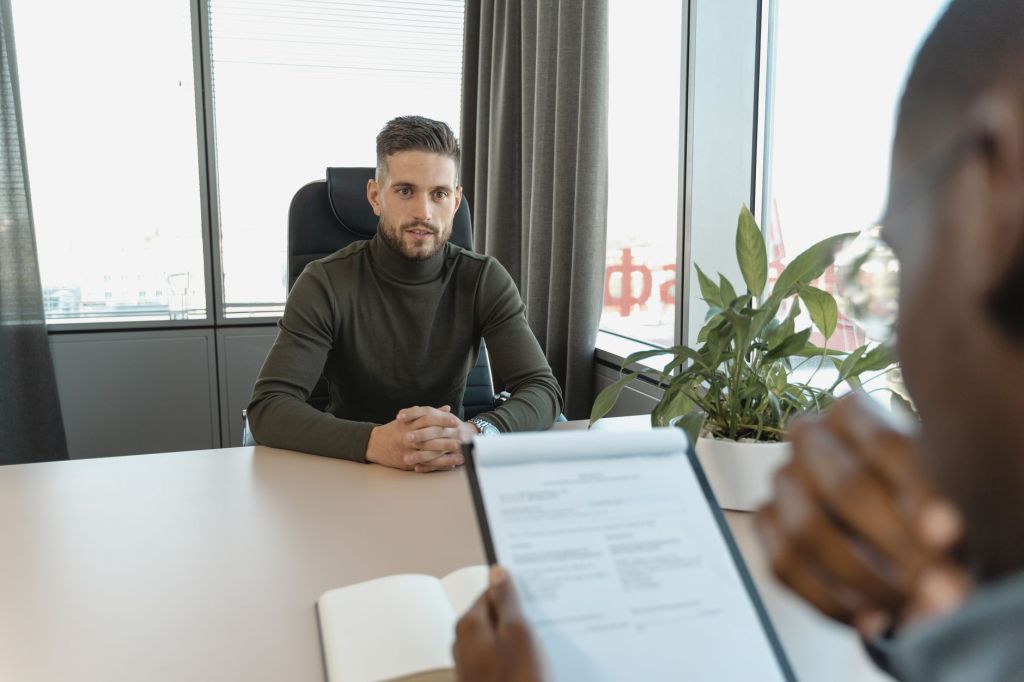
Job interviews are tough and job interviews for neurodivergent candidates can be even tougher that neurotypical ones. This is due to the fact that neurodiverse individuals may have extra struggles with certain aspects of them.
Unfortunately, a lot of employers might not think about how job interviews can go better for their candidates so that they can really show how much of a good fit they are for the roles. They also don’t typically think about whether the candidates are neurodiverse and what that means for the interview. Their focus is on figuring out whether someone can successfully perform the job based on the standard interview format.
The truth is that a lot of common interview practices have little to do with job performances and can actually hinder neurodiverse individuals in interviews. This is because the things they have a hard time with due to their neurodiversity may get tested instead- which might make it seem like they can’t do the actual job well.
So, employers should consider making their job interviewing process more accessible and we are here to help make sure that happens.
Neurodiversity in the Workplace
Neurodivergent candidates do end up getting through job interviews- we’re not saying they absolutely can’t or anything like that. There are MANY individuals who are neurodivergent that are gainfully employed- which is something that should be talked about more.
These neurodiverse individuals who are working part-time or full time for employers are largely invisible and left to deal with an environment that is not inclusive to their needs. They may be high-functioning enough to get and keep the job but that doesn’t mean they aren’t struggling.
Here are common neurodiverse conditions that occur in employees:
- ADHD/ADD
- Autusm
- Dyslexia (reading difficulties)
- Dyscalculia (math difficulties)
- Anxiety disorder
- Bipolar disorder
- OCD
- Sensory processing disorder
- Auditory Processing Disorder
These conditions can affect employees in every way- physically, emotionally, cognitively and socially. This makes it important to have more discussions around neurodiversity in hiring in general.
Job Interviews for Neurodivergent Candidates: What Goes Wrong
As stated before, standard interviews can end up measuring things that don’t have much to do with how well a candidate can perform the actual job. These other largely unrelated things happen to be what a lot of neurodivergent people struggle with. They include the following:
- Eye Contact- People with autism and social anxiety in particular have a hard time with this. To an interviewer, them not meeting their eyes might make them think that they are unable to focus, are lying (yes, we’ve heard that before), don’t know what is going on or aren’t good with others.
- Small Talk- Employers who try to engage in small talk at times throughout the interview might see neurodivergent candidates struggle with it and then be convinced that it will make them have a hard time fulfilling the role. Or they might be put off by them in general because of it- not knowing that the candidate has a condition that makes small talk hard.
- Social Performance- The social skills in general might be hard for neurodivergent candidates. Some are able to mask it but others are unable to do so. Interviewers might take this to mean that their job performance won’t be very good.
- Ability to Think of Answers Immediately- This is a struggle for neurotypical candidates as well. Some interviewers might see the candidate taking a bit of time to answer as not knowing how to do tasks or having the capability of performing well on the job.
- Comfort With Unfamiliar Environments – Neurodiverse individuals might have a hard time being in a different environment than what they are used to/like. This can cause them to have a tougher time with the interview.
- Managing Sensory Distractions- Many neurodiverse individuals have sensory processing issues. This includes sensitivities to certain sounds, sights and smells. If they are sensitive to something in the interview room, they might end up showcasing their discomfort in a way that makes the interviewer think they aren’t right for the role.
- Interpreting Vague Questions- People with autism in particular have a hard time with questions that aren’t literal. Because of this, they might not know how to answer certain questions and the interviewer might end up thinking that they won’t be able to effectively perform the job.
Employers avoiding the testing of these above things is mutually beneficial.
Job Interviews for Neurodivergent Candidates: Making Them More Accessible
Having inclusive interview practices isn’t about making the hiring process easier for candidates-it’s going to be challenging for both parties in most cases. What it does is make sure that the process is actually measuring the skills and qualities the employer needs.
The following are some practices employers should follow for accessible job interviews:
Begin with the Job and Not the Interview-
Before changing the interview, employers should consider what they are really trying to determine. For example, instead of assessing whether someone is charismatic- an employer should consider if they are trying to determine whether they can do things like communicate clearly, solve problems effectively, work independently, handle customer interactions and more. If so, the interview should be designed around those actual requirements instead of whether the candidate seems charismatic.
Basically, if a behavior isn’t important to doing the job, an employer should be cautious about using it as evidence of someone’s ability to perform the job well.
Make Interview Questions More Specific-
Vague questions like, “tell me about yourself,” are really hard for everyone- especially neurodivergent candidates who think literally. This is due to the fact that it requires the candidate to figure out what the interviewer is asking.
Instead, an employer should consider making the questions more accessible by providing specific situations, the skills being assessed, clearer questions and/or enough context to understand the scenario.
Give Candidates Information About the Interview-
Employers providing information on the interview can be very helpful overall and easily implemented. This includes explaining things like the following:
- The interview format
- Approximate length
- Number of interviewers that will be there
- Whether it will be virtual or in-person
- Whether there will be a skills demonstration
- The types of questions or topics
- Whether the candidate should bring anything
- Location and parking/check-in information
A lot of interviewers already do this, which is great as predictability really is a tool- especially for neurodivergent individuals. A candidate shouldn’t have to spend mental energy trying to figure out what the interview will be like before they can even demonstrate what they know.
Allow Processing Time-
Being able to put out an answer immediately is hard for a lot of people. Because of this, employers should allow a few seconds for processing. They also need to know that a short pause to answer doesn’t mean they don’t actually know the answer, they’re unprepared, they’re not confident or that they lack communication skills.
To remedy this, employers can simply allow a few seconds for processing. They can also say something like, “take your time” or “would you like me to co repeat or rephrase the question?”
Don’t Treat Eye Contact as a Proxy for Confidence-
Eye contact varies between people and cultures and can be particularly uncomfortable or distracting for some neurodiverse people. Because of this, an interviewer should focus on what the candidate is communicating instead of if they are looking at me in the expected way.
Consider Alternatives to Rapid-Fire Questions-
The question after question format that interviews typically have can be hard and exhausting for most people. Here are some alternatives to it:
- Provide questions in advance when appropriate.
- Allow written responses for certain questions.
- Use a structured interview format- This can actually improve consistency and fairness for employers as well.
- Give candidates a brief pause between questions.
- Allow for a short break midway through the interview.
Make the Environment Less Distracting-
Not every neurodivergent candidate will have sensory issues but those that do can have their interview performance hindered by the environment. Because of this, interviewers should consider the following issues:
- Bright and/or flickering lights
- Loud waiting areas
- Strong fragrances
- Background conversations
- Unnecessarily crowded interview rooms/spaces
- Uncomfortable seating
- Unexpected interruptions
An employer can’t change everything and make the environment “perfect” but here are some possible solutions to make things more accessible:
- Offer a quieter room
- Change out lights that are flickering
- Reduce unnecessary interruptions by putting a sign on the door indicating that you are busy.
- Provide a virtual option.
- Tell the candidates what the environment will be like beforehand.
- Ask whether they need any reasonable accommodations beforehand.
Don’t Confuse Social Performance with Job Performance-
This was already touched on a bit before but it needs saying again.
A lot of neurodiverse individuals struggle with social situations. Unfortunately, interviewers have a tendency to subconsciously reward job candidates for showing “good” social skills- leading to neurodivergent candidates to be ranked lower in regards to possible job performance ability.
If the things that show “good” social skills aren’t actually requirements of the job- then they should not carry disproportionate weight. It is important for employers to know that a person can be excellent at their job and still struggle with social performance during interviews.
Give Candidates More Than One Way to Demonstrate Skills-
This is a particularly useful employer-facing idea when it comes to job interviews for neurodivergent candidates. Depending on the position, the following could be considered:
- Work samples
- Skill demonstrations
- Portfolio reviews
- Structured scenarios
- Written responses
- Job simulations
- Practical tasks
The point is, if a job requires a skill, whenever possible, consider giving the candidate an opportunity to demonstrate it. This is much more meaningful than trying to infer everything form a 30-minute conversation.
Ask About Accommodations Without Having Candidates Defend Themselves-
Employers can and should make accommodation conversations straightforward and respectful. For example, rather than asking “why do you need that?” they should focus on “what would help you participate full in the interview?”
Also, accommodations should not be treated as evidence that someone will be unable to perform the job.
Implementation of the above inclusive practices won’t make things absolutely perfect for neurodivergent candidates- interviews will still be a relatively uncomfortable experience as it is just the nature of them. They will however make things easier for interviewers to see how they might perform on the actual job.
A More Accessible Interview Doesn’t Mean Lowering Standards-
This is definitely something that needs to be said as it is a common misconception.
Accessible job interviews do not mean the following:
- Hiring someone who isn’t qualified
- Ignoring job requirements
- Giving someone the job automatically
- Eliminating all evaluations
- Never asking difficult questions
An accessible job interview means evaluating candidates using methods that are relevant to the actual work.
Same standards, better measurement.
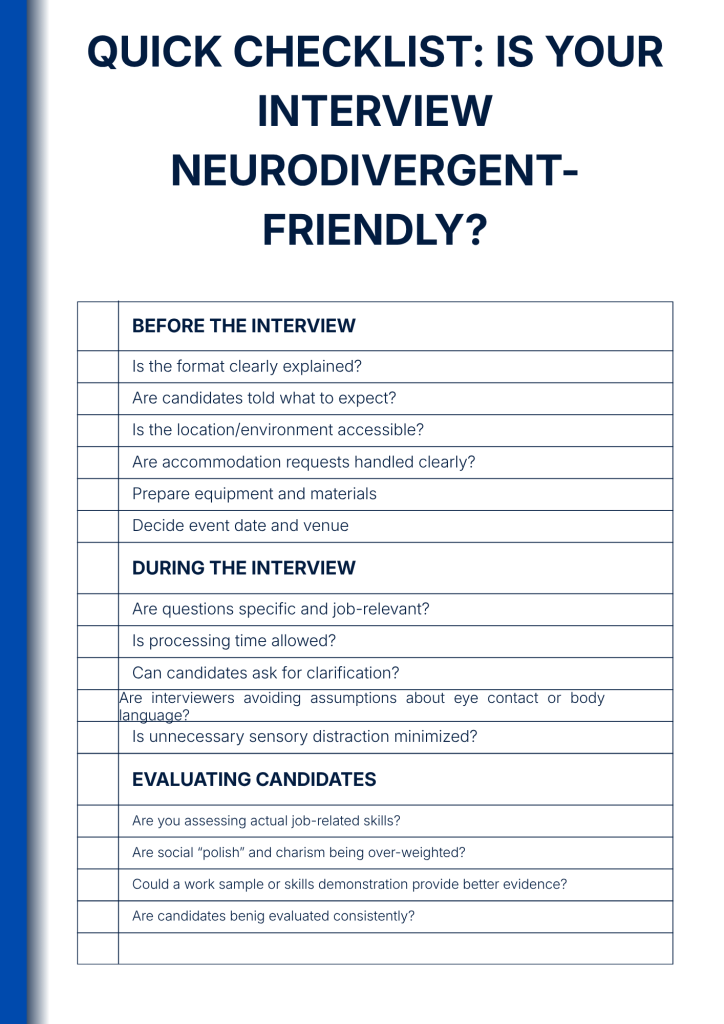
An Accessibility Checklist for Employers
Below is a basic checklist employers can use and think about when they are going to hold interview sessions:
In Conclusion: Accessibility Benefits Better Hiring
A more accessible interview is about removing barriers that can interfere with accurately evaluating a neurodivergent candidate’s abilities- not giving them an advantage. Remember, the best interview is the one that gives you the clearest picture of who can do the job.
We will be creating more content and resources that address adult-accessibility so stay tuned! Also, check out our Etsy store for K-8th grade curricula if you are a parent or a teacher.







 Accessible Pathways