
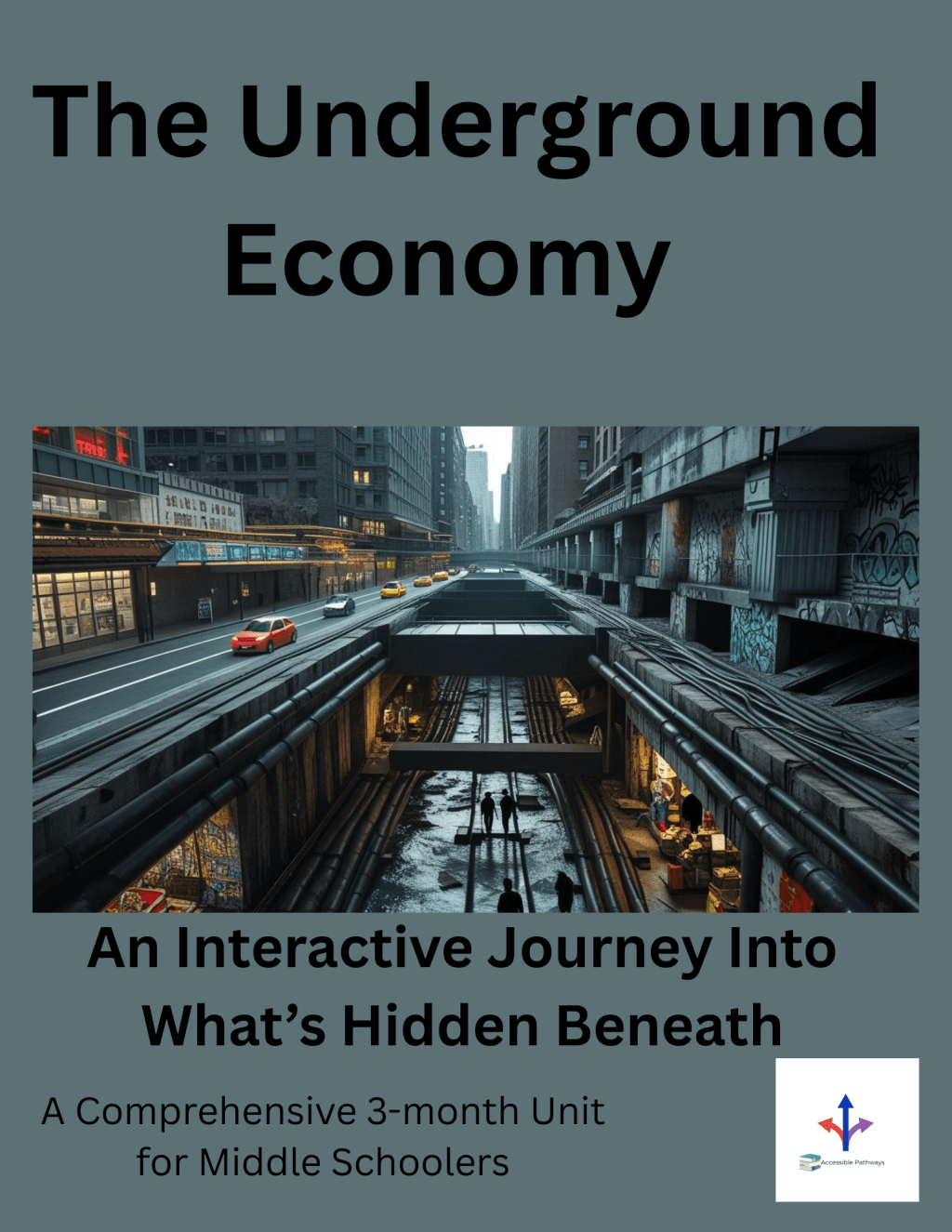
If you’re looking for a middle school economics curriculum that engages students with real-world concepts, exploring the underground economy is an unforgettable way to connect history, math, and critical thinking. Too often, economics is taught in a way that feels abstract or disconnected from students’ lives. By introducing the idea of the underground economy—hidden markets, informal trade, and systems that operate outside traditional rules—you give learners a chance to see how economics affects communities everywhere.
Middle School Economics Studies Are Important
Middle school is the perfect time to spark curiosity about how money, trade, and value work. Students at this age are naturally questioning rules and systems, which makes them especially receptive to topics like:
- Supply and demand (Why do prices go up when something is scarce?)
- Incentives and consequences (Why might people choose to buy or sell “under the table”?)
- Cause and effect in history (How do hidden economies influence cultures, revolutions, or survival in hard times?)
When economics is introduced in relatable, story-driven ways, students begin to see it as more than numbers—it becomes a lens to understand the world.
The Underground Economy as a Learning Lens
The underground economy might sound intimidating, but in a middle school context, it simply means exploring the ways people trade goods and services outside formal systems. Examples can include:
- Street art or busking as informal income
- Historical underground markets during wartime
- Bartering between communities when cash wasn’t available
- Modern side hustles or gig work
These examples help students realize that economics isn’t just what happens in banks or on Wall Street—it’s also the everyday exchanges happening all around us.
Cross-Curricular Connections
A strong middle school economics curriculum ties in with multiple subjects:
- Math: Calculating profit, loss, percentages, and word problems tied to real-life trade.
- Language Arts: Writing persuasive essays, editorials, or reflections about fairness and value.
- Social Studies: Examining historical moments when underground economies shaped societies.
- Critical Thinking: Debating questions like “Is all underground trade harmful?” or “What rules should communities set for fair exchange?”
This makes economics accessible to learners who may not connect with traditional worksheets or lectures, as it utilizes engaging methods to facilitate understanding. By incorporating interactive activities, real-life examples, and multimedia resources, the subject matter can resonate with a diverse range of students.
Making It Engaging for All Learners
Not every student thrives with worksheets—and that’s okay. A curriculum that values projects, discussions, and creative activities gives students more ways to succeed. For example:
- Creating a mock underground marketplace with classroom tokens
- Designing posters about “hidden” forms of trade in history
- Writing from the perspective of someone relying on informal economies
- Tracking cause-and-effect chains in global trade systems
For neurodiverse learners, hands-on and flexible approaches make economics not only accessible but exciting.
Where to Begin
If you want to bring this unique approach into your homeschool or classroom, check out our Underground Economy unit. It’s designed to be:
- Engaging with creative themes and activities
- Cross-disciplinary to strengthen math, reading, and social studies skills
- Adaptable for neurodiverse learners
Check it out here on Etsy: https://www.etsy.com/listing/4372114750/the-underground-economy-middle-school






 Accessible Pathways